
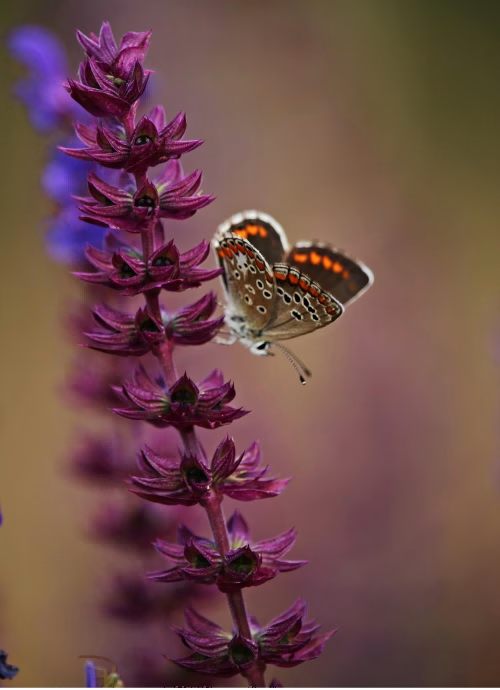
There are many varieties of sage (Sage, Salvia), with approximately 900 known species. These include varieties such as pansy sage and yellow-spotted sage, and even pineapple sage with a fruity fragrance. Flower colors include purple, blue, pink, yellow, white, and red.
Many varieties are cultivated as ornamental plants, while others are used as herbs in cooking. Different varieties have slightly different flavors. Sage originates from the Mediterranean coast of Europe. It looks very similar to lavender, and many people mistakenly confuse the two. However, you can quickly distinguish them by looking at their leaves.
Sage leaves are larger, while lavender leaves are very thin, and the flower shapes are also quite different.
The Status of Sage in Ancient Cultures
Sage has one of the longest histories among all edible and medicinal herbs.
Medicinal Value
According to many documents, the ancient Greeks used sage to stop bleeding and reduce inflammation, and it could also treat ulcers. Drinking warm water infused with sage could also stop coughs. The ancient Egyptians even used sage as a fertility remedy.
Sage remained popular in the Middle Ages. A poem circulating in Europe at that time contained the line “Cur moriatur homo cui salvia crescit in horto?” This Latin phrase means “Why should a man die who has sage growing in his garden?” At that time, sage was considered a medicinal herb capable of curing difficult diseases and was therefore highly regarded.
Culinary Ingredient
Besides being used as a medicinal herb, sage was also used in many European dishes, especially a dish called “Saltimbocca”.
Sage, found in Italy, Spain, Greece, and southern Switzerland, is a meat dish made by combining prosciutto, steak, and sage, then pan-frying it. Because it’s so delicious, people can’t help but keep eating it, hence the name “Saltimbocca” (meaning “jumping into the mouth”).
Sage Cultivation
Sage can be grown directly from seeds or through cuttings. The care methods may vary depending on the variety.
Generally, when growing indoors, place it near a sunny window. However, some varieties are not recommended for excessive direct sunlight in summer. When purchasing sage, remember to ask the seller how to properly care for that variety.
Sage tolerates dryness well; water only when the soil is dry, but avoid keeping the roots moist. Therefore, when planting sage, it’s recommended to mix the soil with a well-draining medium, such as vermiculite, tree fern fiber, or expanded silica. When preparing sage, simply cut off the amount needed with scissors.
Culinary Applications of Sage
Sage has a strong flavor, so using just one or even half a leaf is sufficient for cooking. Fresh sage tastes better than dried sage.
Sage can be paired with various meats such as beef, pork, chicken, lamb, and fish, and can be prepared in a variety of ways. Besides common methods like pan-frying, stir-frying, and stewing, it can also be used as a filling, added to marinades, or made into sauces. Sage tea is also a delicious option.

Leave a Reply